The best exercises for a complete back workout
The best exercises for a complete back workout

The back is not only one of the largest and strongest parts of the body, but it is also one of the most complex areas due to the series of interconnected muscles that make it up. That is why we divide the back into four main regions : upper and outer thoracic, lower thoracic, mid-back, and lower back . Each area requires specific stimulation through different exercises, so we'll look at the best two for each of the four.
With the "menu" that we will present below, you can customize your own training by selecting an exercise for each area, to form a complete routine for the back. If you notice that there is an area that is more difficult to advance, you can also include additional exercises to reinforce that area further behind. Ultimately, it is about understanding what exercises each area works, to have the ability to build a back with the shape (normally, V back ), the thickness and the width that you want.
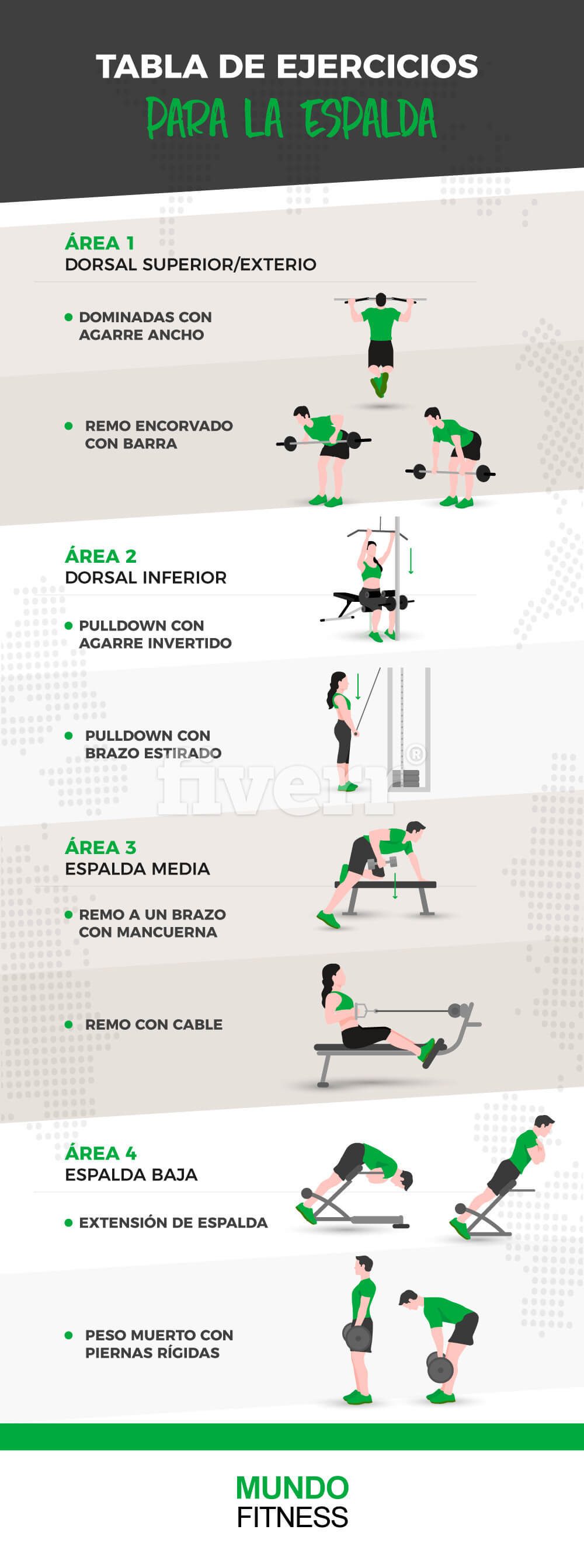
As a small note, we add that the exercises in this guide do not isolate, but rather emphasize certain areas of the back muscles.
Area 1 - Upper / outer bib
Make movements in which you use a wide grip - usually a width greater than that of the shoulders - with which we can develop a back in V. He usually does the exercises taking an angle above the head, or perpendicular to the body.
The best exercises : dominated and I bent barbell rowing , wide grip both years.
Wide grip pull-ups

- Grab the bar with an overhand grip . Fully extend your arms and relax your shoulders to stretch your lats in the lower position.
- As you go up, keep your elbows out to the side and help yourself to lift yourself up as your lats contract.
- Try to climb as high as possible to fully stimulate your lats.
- If you can't quite lift yourself up, consider seeking the help of a partner or an assisted pull-up machine .
To add difficulty and effectiveness, squeeze your shoulder blades when hanging with your arms fully extended.
Bent over barbell row

- Don't stand on a bench or platform to increase your range of motion; your lower back is more likely to hunch. If you need a greater range of motion, use smaller plates to get closer to the ground, rather than trying to balance on a bench.
- Using a grip greater than shoulder width will allow you to keep your elbows out to the side and pull back as far as possible for a full contraction.
- Keep your knees bent and the stooped row posture throughout the exercise. It's easy to lose posture when lifting heavy weights, but in any case, other muscles that function as auxiliary aides are also joining the movement.
For a more intense exercise, try to bring the bar up to your upper abs with each lift.
Area 2 - Lower Dorsal
For more emphasis on the lower lats, use a tight, inverted grip for chin-ups and pulldowns. One of the few movements to work lats together is the straight arm pulldown.
Best exercises : reverse grip pulldown and straight arm pulldown .
Reverse grip pulldown
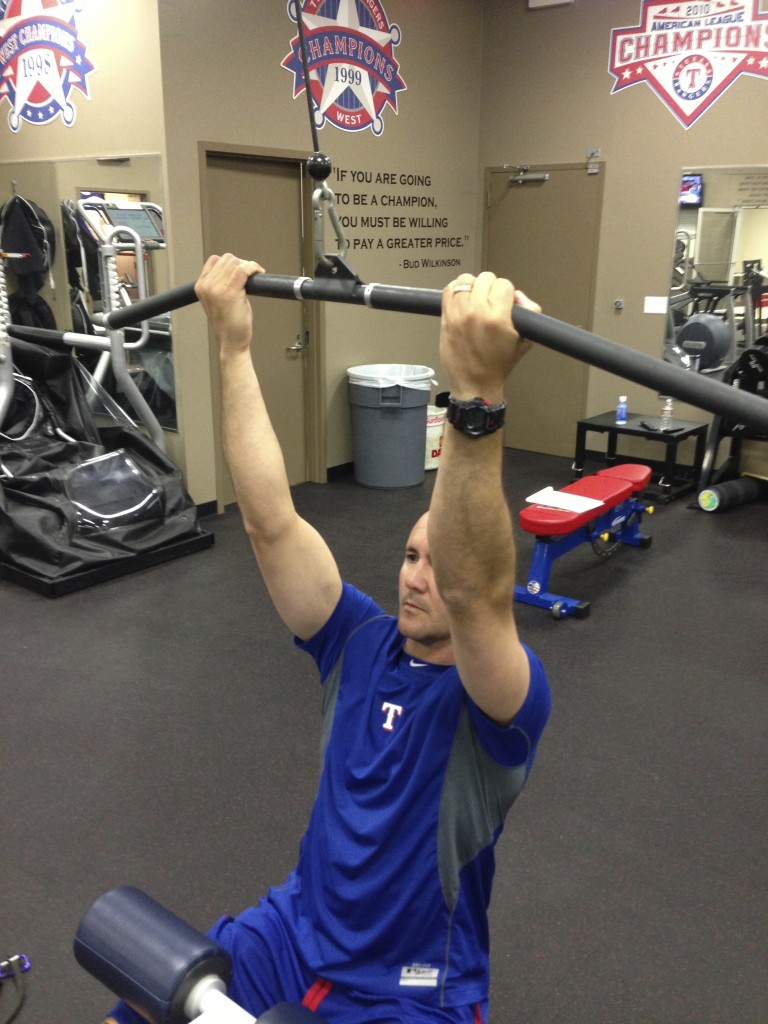
- With your palms facing your face, grasp the bar about shoulder width apart. This position allows us to bring the elbows back, as far as possible, stimulating the muscles of the back to the maximum.
- Keep your torso upright, making only a slight arch in your back when your arms are fully extended at the top of the movement. The chest accompanies the back in that slight hunch, but when we bring the bar to the chest, we pull it out to concentrate more tension on the back muscles.
- Pull your elbows as far back and down as you can until the bar approaches your upper pecs. Squeeze your shoulder blades at the point of maximum contraction.
Pulldown with outstretched arm

- Grab the horizontal bar above your head, standing, and far enough that you can keep your arms fully stretched throughout the movement all the way down (just slightly bending your elbows).
- Lower the bar with your arms straight until it touches your thighs. Concentrate on feeling the movement in your lats. The arms should act only as levers.
- The movement should be done only in the shoulder joints.
For optimal stimulation of the lower lats, do not stop the movement once the bar touches your thighs, but re-squeeze the lats, pressing once more towards the thighs.
Area 3 - Mid back
To work this zone, use closed and medium rowing grips, in which the bar, dumbbell or handle is pulled towards the abdomen or to the sides for better muscle building.
The best exercises : rowing a dumbbell arm and paddle cable .
One Arm Dumbbell Row

- Bend forward at the waist and place your right knee and right hand on a flat bench.
- Keep your left foot on the ground while holding the dumbbell with your left arm. Let the weight hang slightly forward, with the arm fully extended.
- Pull the dumbbell toward your hips, keeping your elbow next to your body.
- Keep your back straight and your abs tight. Bring your elbow as high as you can. At the top of the movement, squeeze your shoulder blades and then lower the weight the same way.
- Repeat this movement until the end of the set, and switch arms.
Cable rowing

- Sit with your knees slightly bent to reduce pressure on them and maintain better balance.
- Although you might think that leaning your body forward would give you a greater range of motion, keep your torso upright, because this works the middle back better, while reducing stress on the lumbar region.
- Keep a slight arch in your lower back at all times.
- Pull your shoulders and elbows back as far as possible so that the handles touch your abdomen.
To add difficulty to the exercise, hold on for a second or two at the moment of maximum contraction, and squeeze your shoulder blades for optimal muscle stimulation.
Area 4 - Lower back
The exercises to work this area require the bending of the waist, and not the hips, since with these we would be working glutes or hamstrings, for example. It is a critical area to strengthen and thus prevent back pain.
Best exercises : back extension and stiff-legged deadlift .
Back extension
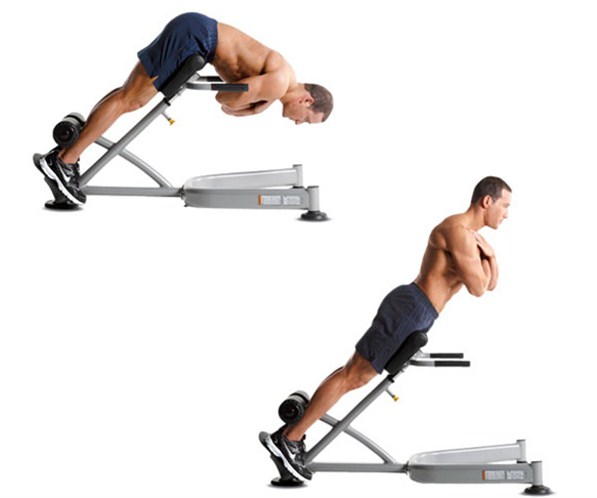
- Once on the back extension bench, cross your arms over your chest or behind your head (this increases the difficulty). Optionally, a weight plate can be added close to the chest to increase intensity.
- Slowly bend at the waist as far as you can, curving your back as you go up.
- Contract your lower back muscles to lift your torso back to the starting position. Do not make movements that are too sudden or fast, and avoid reaching too high, since hyperextension of the back is not a good idea.
Adjust the bench so that your hips are perfectly contoured, preventing them from shifting and concentrating force on your lower back muscles.
Stiff-legged deadlift
- Unlike the Romanian deadlift, here the bar is closer to the ground, making your lower back work harder for the wider range of motion.
- When we bend forward by bending at the waist, the glutes go back and we allow the bar to hang freely with the arms fully extended. The legs must be straight.
- Keep your lower back muscles engaged throughout the descent.
- Push your hips forward as you lift yourself up. Stand up without leaning your upper body back. The bar should rest on the upper thighs.
- Focus on straining your back and hip muscles, not your arms as you lift your torso.
Unlike the Romanian deadlift, it allows your lower back to hunch slightly when you are in the lower position of the exercise.
Training plan
- Include an exercise in your routine that targets each area of your back.
- To build muscle mass, do 2-3 sets of 8-12 reps. To strength train, work with more weight and low rep sets (4-7 reps). For muscle definition and endurance, work lighter and do high-rep sets (15-25 reps).
A workout that focuses on building upper / outer lats, but still touches all areas of the back, would be something like the following graph, which does not include warm-up sets. Rest 1-2 minutes between each set.
| Exercise / Focus Area | Series | Repetitions |
| Pull-ups (wide grip) / Outside latch | 3 | 12, 10, 8 |
| Bent Over Barbell Row / Outside Dorsal | 3 | 8, 10, 12 |
| Cable Row / Mid Back | 3 | 8, 10, 12 |
| Reverse Grip Pulldown / Lower Lat | 3 | 12, 10, 8 |
| Back Extension / Lower Back | 3 | 12, 12, 12 |
Don't forget to download your free infographic to be able to follow the best exercises for a complete back workout to the letter. Let's do it!
Comments
Post a Comment